

By Wendy Sibiya
For women in Komati, getting information about breast health is one thing. Knowing where to go for an examination or further testing is another.
What happens when a woman in Komati wants to check her breasts?
The answer depends on where she goes, whether the mobile clinic arrives and whether she can afford the journey for further tests.
Komati News Flash spoke to healthcare professional Sister Zulu, who works with Mobile 2, about the breast health services available to women in the community.
What breast health services are available in Komati?
According to Sister Zulu, access to specialised breast health services in Komati is limited.
There is no permanent breast clinic or mammography unit in the community.
Women rely largely on mobile and primary healthcare services for initial examinations and referrals.
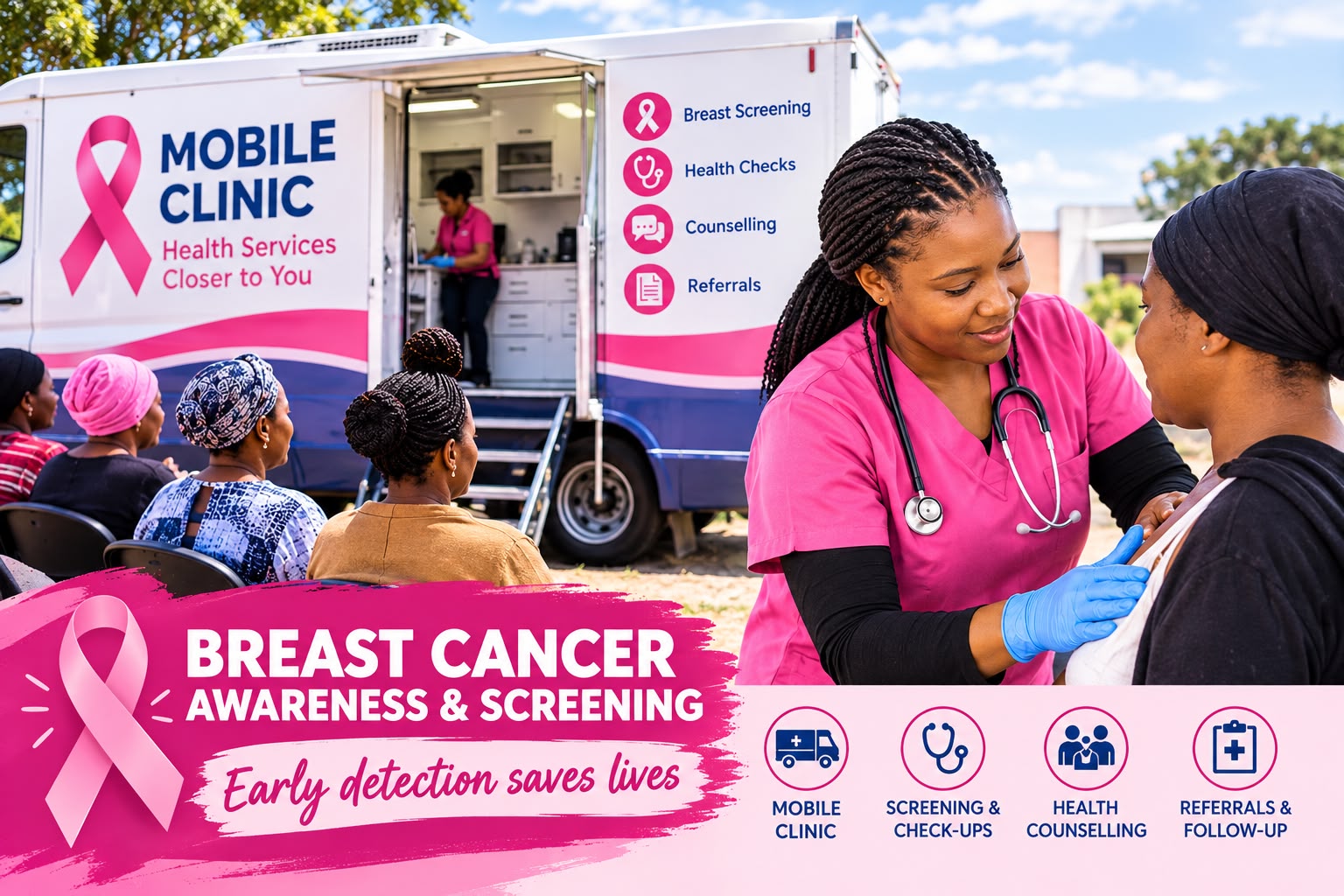
Mobile 2 visits the area twice a week, with services offered on different days.
On Mondays, the service focuses on maternal and child health, including antenatal care.
Then on Wednesdays, the service is open to women in the wider community.
The mobile unit usually operates from a central point near the community hall, making it possible for women nearby to walk to the service or use local transport.
According to Sister Zulu, women can receive clinical breast examinations and health education, and those who need further investigation can be referred to a hospital.
Sister Zulu describes Mobile 2 as a lifeline for women who might otherwise struggle to access healthcare.
-local clinic nurse, sister zulu
“Many women who would never have gone for a breast check have been examined and referred accordingly because the service comes to them,”
But reliability remains an issue.
When the mobile clinic does not arrive as expected because of operational challenges, vehicle problems, staff shortages or other circumstances, women may have to wait for the next visit.
For someone who has already taken time off work, arranged childcare or made plans to visit the clinic, another missed day can mean delaying care.
Sister Zulu says repeated disruptions can also affect confidence in the service.
What happens when a woman needs further tests?
A clinical examination is not the end of the process if an abnormality is found.
A woman may receive a referral for further investigation, such as a mammogram or ultrasound, at a hospital outside the community.
This is where transport becomes an important part of the healthcare journey.
For women who are unemployed or living on limited household incomes, the cost of travelling to another town or spending a day away from work and family responsibilities can make follow-up more difficult.
Sister Zulu says some women delay or do not complete recommended follow-ups because of these practical challenges.
But what are women in Komati saying?
Komati News Flash also spoke to two female residents who requested to remain anonymous about their experiences and understanding of breast health services.
One resident said she had never gone for a breast examination.
“If I were to do so, I’d go to our nearest public hospital. Or a fixed clinic,”
Her response raises an important question: how many women know exactly where to go when they want to have their breasts checked?
The resident also said she had not been taught how to perform a breast self-check.
“Our mobile clinic doesn’t offer screening. I’ve never asked to check my breast and they have never offered either. I’ve never been taught how to check my breast for myself,”
Sister Zulu, however, says health education and breast examinations form part of the services provided through Mobile 2, although what is offered can depend on the day and the demands on the service.
“Sometimes the clinic it doesn’t come”
The resident confirmed that she knows Mobile 2 visits Komati twice a week.
“Our mobile clinic comes twice a week, Monday and Wednesday. Sometimes it doesn’t come on the day it’s supposed to come, you wait for the next [one] or if it doesn’t show up at all,”
This points to a broader issue raised by Sister Zulu, access is not only about whether a service exists. It is also about whether people can rely on it.
But what happens after a referral?
The resident said she understood that she could be referred to a hospital for further tests such as a mammogram or ultrasound.
For women in Komati, that can mean leaving the community to access services that are not available locally. While transport can add another layer to the process.
The resident said a trip to the hospital costs her around R65, which she described as manageable based on her own experience.
However, not every woman is in the same financial position.
For an unemployed woman or someone responsible for a household on a limited income, even a relatively small transport cost can become another consideration when deciding whether to seek care.
What needs to change?
Sister Zulu says improving breast health access in Komati will require more than an October awareness campaign.
She suggests:
• More reliable mobile clinic services, with communication to residents when a scheduled visit cannot take place.
• Better referral follow-up, so that women who are referred for further tests are not left to navigate the process alone.
• More breast health education throughout the year, rather than concentrating awareness efforts in October.
• Expanded mobile services, where possible, including occasional access to diagnostic services.
• Transport support for women who need to travel for further testing.
• Stronger links between breast health and other primary healthcare services, including antenatal care and family planning.
For one Komati resident, the solution starts with having breast examinations available closer to home.
“Maybe if the clinic offered examination.”
Awareness is not enough if women don’t know where to go
Breast Cancer Awareness Month often brings pink ribbons, campaigns and reminders about early detection.
But in Komati, the conversation needs to go one step further.
If a woman feels a change in her breast today, where does she go?
If she needs an examination, can she access one locally?
If she is referred for a mammogram or ultrasound, can she afford the journey?
And if the mobile clinic is not there on the day she planned to visit, does she know what to do next?
For Komati women, breast cancer awareness cannot only be about knowing that breast cancer exists.
It also has to be about making sure women know where to go, how to get there and what happens after they ask for help.