


By Samkelisiwe Mhlanga
MIDDELBURG – Commuters in Middelburg are facing a double financial blow as rising fuel prices and increased taxi fares continue to strain already stretched household budgets.
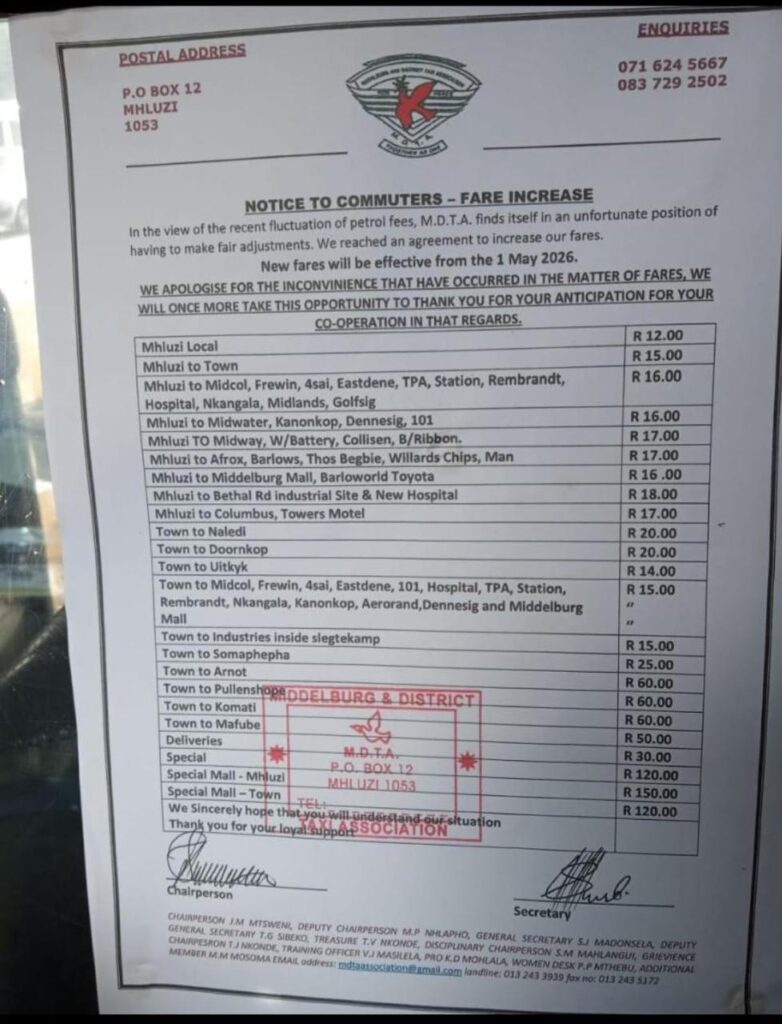
The Middelburg and District Taxi Association implemented fare increases on Thursday, 1 May, citing soaring operational costs, particularly fuel. This comes as petrol and diesel prices climb sharply, with inland petrol expected to approach R30 per litre in early May.
Latest projections show the following:
Unleaded 93, currently sitting at around R26.50 per litre, could climb close to R29.50. Unleaded 95 is also likely to increase from about R26.99 to nearly R30 per litre. While diesel, which already jumped to R36.95 after a steep increase in April, is also expected to go up even further, adding more pressure on taxi operators and, ultimately, commuters.
For many residents, the impact is immediate and severe.
“I rely on taxis every day, and now I have to spend more just to get to work,” said a commuter from Mhluzi. “It might seem small, but it adds up over time.”
Bongekile Dlamini from Nyanyathu described the increase as unbearable. “My return trip is now R30. I don’t earn enough to provide for my children, and we are already paying high municipal rates. Many of us will have to walk to work,” she said.
The burden is not only felt by workers. Learners are also affected, with some now forced to walk long distances to school.
“We arrive tired and struggle to concentrate in class,” said a Grade 11 learner from Mhluzi. “Transport costs have become a real problem for us.”
Taxi operators, however, argue that the increases are necessary. One local taxi owner said the rising cost of diesel has made it difficult to remain profitable.
“We were not making a profit. Diesel is expensive and we still pay instalments on our vehicles. With the new fares, we hope to at least break even,” he said.
The South African National Taxi Council (Santaco) has also acknowledged the pressure on operators, noting that diesel-reliant taxis have been hardest hit, especially with the expiry of the temporary fuel levy relief.
Global Pressures, Local Impact Fuel price increases in South Africa are closely linked to global oil market instability. Ongoing conflict in the Middle East has contributed to supply uncertainty, pushing prices higher worldwide.
But in communities like Middelburg, the consequences go beyond global economics, they are deeply local and personal.
The Just Energy Transition Factor For Komati and surrounding areas, these challenges are unfolding against the backdrop of the Just Energy Transition (JET). As the region shifts away from coal-based energy, many households are already dealing with job losses, reduced economic activity, and financial uncertainty.
The rising cost of transport adds another layer of pressure to a community already in transition.
For residents who depend on daily commuting for work, education, and access to basic services, taxi fare hikes are not just an inconvenience, they are a direct threat to livelihoods.
Higher transport costs also mean less disposable income, affecting local businesses and slowing down economic recovery in a town still adjusting to structural change.

Calls for Relief and Engagement
Community members are now calling for greater transparency and engagement from taxi associations when fare increases are introduced, as well as broader support to cushion vulnerable households.
As Middelburg navigates both global economic shocks and the realities of the energy transition, the situation highlights a critical issue: without targeted support, the burden of change continues to fall on those least able to afford it.
For Komati News Flash, these are the stories that matter, where global decisions meet local realities, and where communities in transition must find a way forward.